
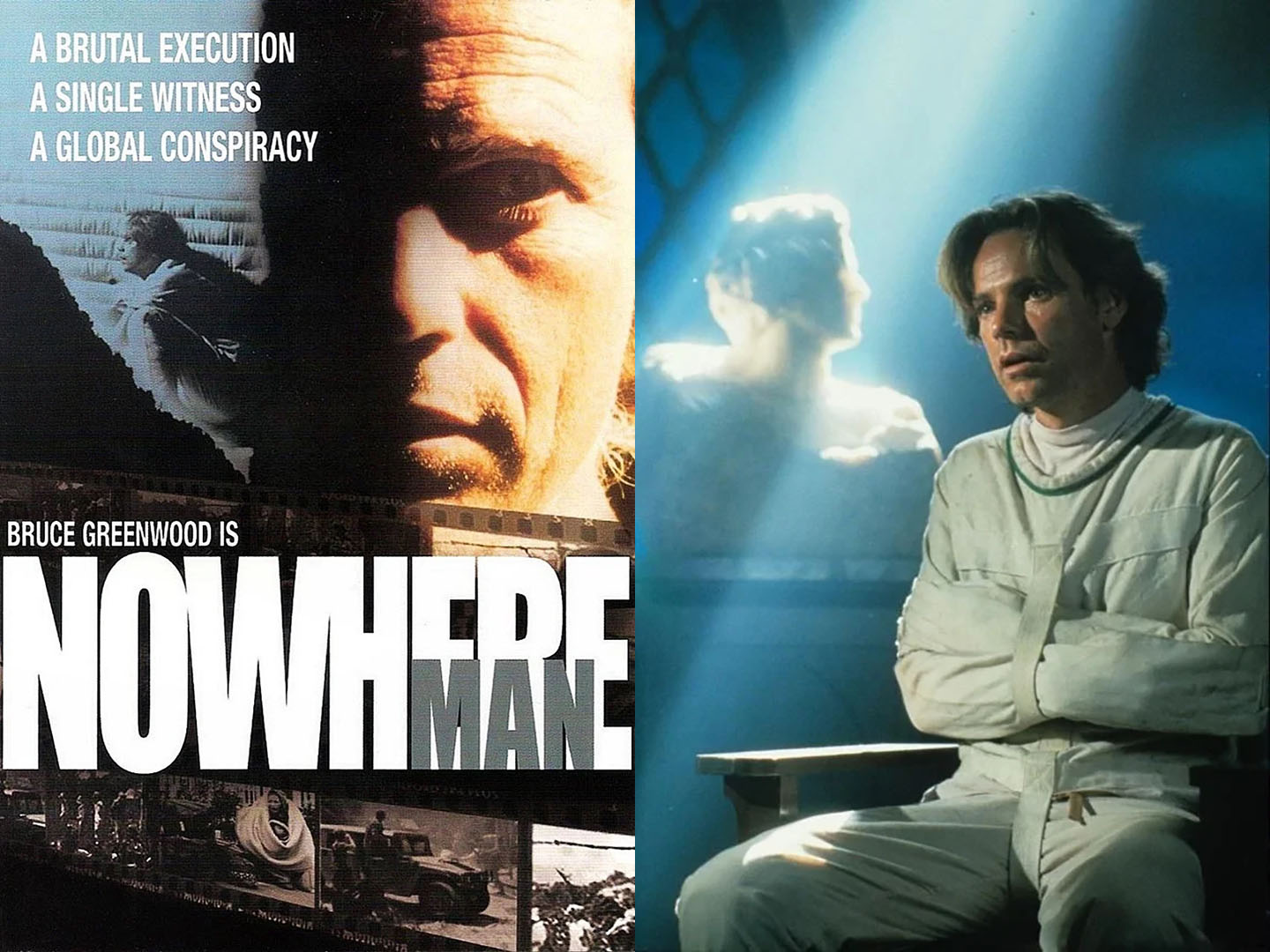
I was twelve years old when Nowhere Man premiered on UPN in August 1995, and I watched every episode with the lights off, alone, which in retrospect explains a lot about me. Most people my age were watching Friends. I was watching a photojournalist lose his entire identity to a shadowy government conspiracy and slowly go feral trying to claw it back. We are not the same.
If you’ve never heard of it, that’s actually kind of the point.
What it Was
Nowhere Man ran for one season on UPN, 25 episodes, from August 1995 to May 1996. Created by Lawrence Hertzog, it starred Bruce Greenwood as Thomas Veil, a photojournalist who one night steps away from a dinner with his wife for a few minutes and returns to find she doesn’t recognize him. His credit cards don’t work. His studio belongs to someone else. His best friend turns up dead. His mother has had a stroke and can’t confirm he exists. Every trace of Thomas Veil has been systematically deleted, and the reason, as far as he can piece together, is a single photograph he took called “Hidden Agenda”: four men being hanged by U.S. soldiers in what appears to be South America. He has the negative. They want it back. The hunt is on.
Each episode sees him running from city to city across America, trying to find allies and getting betrayed by almost all of them, trying to understand who erased him and why, and trying to hold onto his own sense of self when the entire infrastructure of modern identity has been weaponized against him. Hertzog acknowledged his influences openly: The Prisoner, The Fugitive, The Manchurian Candidate. His own framing for the central question was simple:
“Let’s take everything away from him. Without that, who is he?”
That question sits at the heart of every episode and it does not get less disturbing the more you sit with it.
Why it’s Horror
It wasn’t marketed as horror. It was filed under “mystery sci-fi thriller” and aired right after Star Trek: Voyager on Monday nights, which tells you everything about how UPN was thinking about it. But I’m telling you, as someone who has spent her entire life cataloguing things that frightened her, Nowhere Man belongs in the horror conversation.
The horror isn’t monsters or gore. It’s bureaucratic. It’s the terror of being told you don’t exist by the systems designed to confirm that you do. It’s watching a man’s wife look him in the eye and claim not to know him, and wondering whether she’s been coerced or whether she genuinely believes it, and realizing you can never be sure which is worse. It’s the conspiracy that never fully reveals itself, the organization that has no name, the antagonists who are just ordinary-looking people doing a job. That is scarier to me than almost anything with a mask and a knife.
Tobe Hooper directed two episodes, “Turnabout” and “The Incredible Derek,” which tells you something about the show’s sensibility. The man who made The Texas Chain Saw Massacre felt at home here. Mark Snow, who scored The X-Files and Millennium, composed the music; that moody, spare theme that plays as Veil drifts to his next nowhere destination is exactly as unsettling as it should be.
Bruce Greenwood is the Whole Show
This cannot be overstated. Bob Keen said 95% of what Pinhead is comes from Doug Bradley. The same math applies here: 95% of what Nowhere Man is comes from Bruce Greenwood. He had to carry every single episode almost entirely alone, with supporting characters rarely appearing more than four times across the whole season, and he does it with this quality that someone on the old IMDb boards described better than I can: he plays Veil as “a quarter of a bubble off, a semi-tone out,” slightly strange even while being an everyman, so you identify with him completely while also sensing that his pre-erasure life may not have been quite as innocent as he believes.
That ambiguity is crucial. The show periodically suggests that Veil himself may have manufactured or participated in some of what’s happening to him, that “Hidden Agenda” may have a more complicated moral history than he admits, that the man being persecuted may not be entirely the victim he thinks he is. It never resolves that cleanly. Greenwood holds all of it at once.
What Happened to It
Nowhere Man premiered to decent numbers and was called “this season’s coolest hit” by TV Guide. Then it got canceled anyway, because Hertzog got into fights with UPN and Touchstone over the show’s direction, and eventually 24 writer Joel Surnow was brought in to run things, and by the end Hertzog had been effectively squeezed out of his own series. It was replaced by The Burning Zone, a disease-of-the-week thriller that nobody remembers because it was not very good.
The finale, “Gemini,” does provide something resembling closure, though fans are divided on how much. It answers some questions while strongly implying that the answers don’t mean what Veil hoped they would. If you’ve seen The Prisoner finale, you’ll see this one coming. If you haven’t, it will either feel devastating or deeply satisfying depending on your tolerance for ambiguity. I found it both.
The Problem of Finding it Now
Here’s where the show’s themes become almost too on the nose: Nowhere Man has never been available on any streaming platform. Not once. It’s not on Netflix, Hulu, Max, Paramount+, Peacock, Shudder, Tubi, or anywhere else. The complete series was released on DVD in 2006 by Image Entertainment and has since been deleted, meaning the physical discs are now increasingly rare and expensive to find. Amazon has the set listed but copies aren’t cheap and availability comes and goes. Your best free option is searching YouTube for full episodes, where a surprisingly complete archive exists, uploaded by fans who clearly decided the show’s erasure from official channels was not going to be the end of the story.
A show about a man erased from every record has been erased from every streaming record. I don’t know whether to find that poetic or infuriating. Probably both.
Why You Should Watch It
We live in 2026. Surveillance capitalism is real. Your phone knows more about you than your closest friends. The idea that a sufficiently motivated organization could erase your digital existence overnight is no longer science fiction, it’s a threat model. Nowhere Man understood this in 1995, when the internet was still mostly a novelty and the idea of identity as something stored in databases was still abstract for most people. It understood that the truly terrifying conspiracy isn’t the one that hunts you down with guns; it’s the one that makes other people sincerely believe you were never real.
If you like The X-Files, you owe it to yourself to watch this. If you like The Prisoner, even more so. If you’re the kind of person who thinks the scariest horror is the kind that doesn’t need a monster, then Nowhere Man was made for you and the fact that you haven’t seen it yet is one of television history’s quiet injustices.
Greenwood went on to have a great career. Nowhere Man went nowhere. But it deserved better, and so do you.
💜 Now if you’ll excuse me, I have fog to walk into.
Support Halloween Love
If an item was discussed in this article that you intend on buying or renting, you can help support Halloween Love and its writers by purchasing through our links:
