
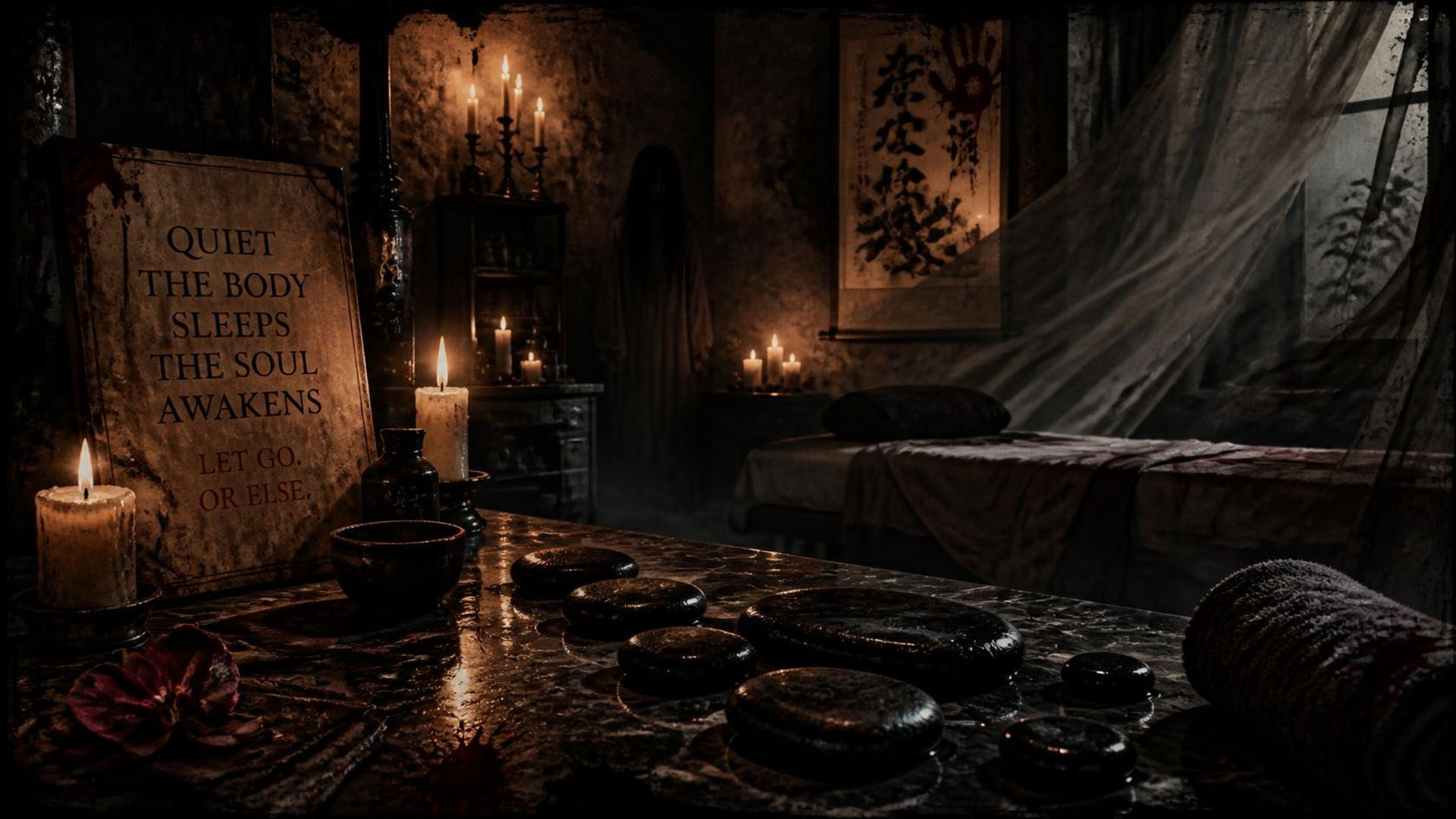
Every haunted house movie hits the same beat. Somebody lights a candle, somebody else says the word “relax,” and roughly ninety seconds later a door closes on its own. Horror understands atmosphere better than any other genre going, which makes it a little strange that nobody thinks to borrow the toolkit for something that ends well.
Because the overlap is enormous. A spa and a seance run on identical hardware: low light, warm stone, a smell nobody can quite name, and a score built to make the back of the neck do something involuntary. Swap the intent and the setup barely changes.
So consider this the project. Take the visual grammar of a Gothic horror film, remove the murder, and build a massage room at home that feels like being pampered inside a Hammer production. It costs less than a decent boxset, and unlike a jump scare, the effect lasts more than four seconds.
Light First, Because Everything Else is Negotiable
Overhead lighting has never once improved anything. Kill it. The single biggest upgrade available here is turning off the ceiling fixture and lighting the room from below waist height, which is the exact trick cinematographers have used since Nosferatu to make a familiar face look wrong.
Candles do the heavy lifting, and the flicker matters more than the count. Real flame moves at an irregular rhythm the eye reads as alive, which is why a room lit by eight tealights feels haunted and a room lit by one LED puck feels like a dentist’s waiting area. Cluster them at floor level and on low surfaces. Put nothing within arm’s reach of a table, and nothing at all near hair, sleeves, or draped fabric.
For colour, there are two schools. The restrained option is deep amber, which flatters skin and reads as gaslight. The unhinged option is Argento: gel a corner lamp in saturated red and another in bilious green, aim them at opposite walls, and let the shadows fight it out in the middle. Suspiria did this with three-strip Technicolor and a lot of nerve. A five-pound sheet of theatrical gel gets surprisingly close.
The Stones Are the One Horror Prop That Genuinely Works
Hot stone massage uses basalt, which is what happens when lava cools quickly and locks in a dense, fine-grained structure full of iron. That density is why basalt holds heat for twenty minutes when a decorative river pebble goes cold in three. The stones on a therapist’s table were, at one point, moving very fast in the wrong direction underground. Good luck finding more on-theme material.
Heat them in water, never in a microwave or an oven, and check the temperature before the stones touch anyone. Professional practice keeps working stones in a fairly narrow band, and the American Massage Therapy Association publishes guidance on safe handling that is worth reading before improvising with a saucepan. A stone that feels merely warm to a hand can still be too hot for the spine, and burns are the least atmospheric injury imaginable.
Now the fun part. Chill a second set of stones, or a few flat pieces of marble, in the fridge for an hour. Alternating warm and cold across the shoulders produces a jolt that the nervous system files somewhere between pleasure and alarm, which is the exact register horror operates in. Contrast therapy has a long history in sports recovery, and the Cleveland Clinic covers the sensible version of it in plain language. Applied at a slow pace, warm stone then cold stone then warm again, it turns an ordinary back rub into something the body pays attention to.
Sound is Where Most Attempts Fall Apart
The instinct is to reach for a horror soundtrack. Resist it slightly. Anything with stings, screams, or a sudden brass hit will spike a heart rate that the entire rest of the setup is trying to slow down.
What works is the connective tissue between the scares. John Carpenter’s Halloween theme is famous, but the ambient cues buried in his scores are the real find: patient analogue synth, minimal melody, a pulse that sits just under a resting heartbeat. Goblin’s quieter passages from Profondo Rosso do the same job. So does almost anything by Disasterpeace, and so does an hour of dungeon synth, a genre that exists more or less entirely for this purpose whether it admits it or not.
Volume should be low enough that the sound registers as weather rather than music. If a track can be hummed along to, it is too loud.
Scent is the Cheapest Fear Money Can Buy
Smell reaches the emotional wiring of the brain faster than sight does, which is why a single note can drag someone back to a childhood hallway. Used deliberately, it does more work than any prop.
Skip pumpkin spice unless the goal is comedy. The genuinely eerie register is older and mineral: myrrh, frankincense, clove, smoked cedar, black tea, damp earth. Beeswax candles smell faintly of church. A drop of vetiver oil on a warm stone smells like a cellar in the best way. Anything applied to skin needs a carrier oil and a patch test on the inside of the forearm twenty-four hours ahead, because an allergic reaction is a genuinely awful way to end a relaxing evening.
Where the Horror Should Stop
The atmosphere is theatre. The bodywork underneath it should be boring and correct. Keep pressure moderate, avoid the spine itself, work with the muscle rather than into the joints, and stop immediately if anything sharp registers. Nobody needs a genuine injury for the sake of a bit.
It is also worth stealing from people who stage rooms for a living. Studios that build sessions around candlelight, warm oil, and a deliberately slow pace have solved most of these problems already, and a session with an outfit like erotic massage in London is an efficient way to see how professionals handle heat, timing, and lighting before recreating any of it at home. Pay attention to the transitions. The pacing is what separates a proper session from a nice idea executed badly.
A Better Class of Chill
The reason this works is that horror and relaxation are chasing the same physiological response from opposite directions. Both want a body that has stopped scanning the room. Horror gets there by overloading the alarm system until it gives up; a good massage gets there by switching the alarm off gently.
Run them together and something odd happens. The candlelight and the drone and the cold stone on a warm shoulder produce a mood that is not quite fear and not quite calm, just heightened. Every sound in the house becomes interesting. Nothing bad is going to happen, and some part of the brain refuses to believe it.
That tension is the whole point of the genre, and for once it can be enjoyed lying face down with a hot rock between the shoulder blades. October is right there. The candles are already in the cupboard.
Support Halloween Love
If an item was discussed in this article that you intend on buying or renting, you can help support Halloween Love and its writers by purchasing through our links:
