
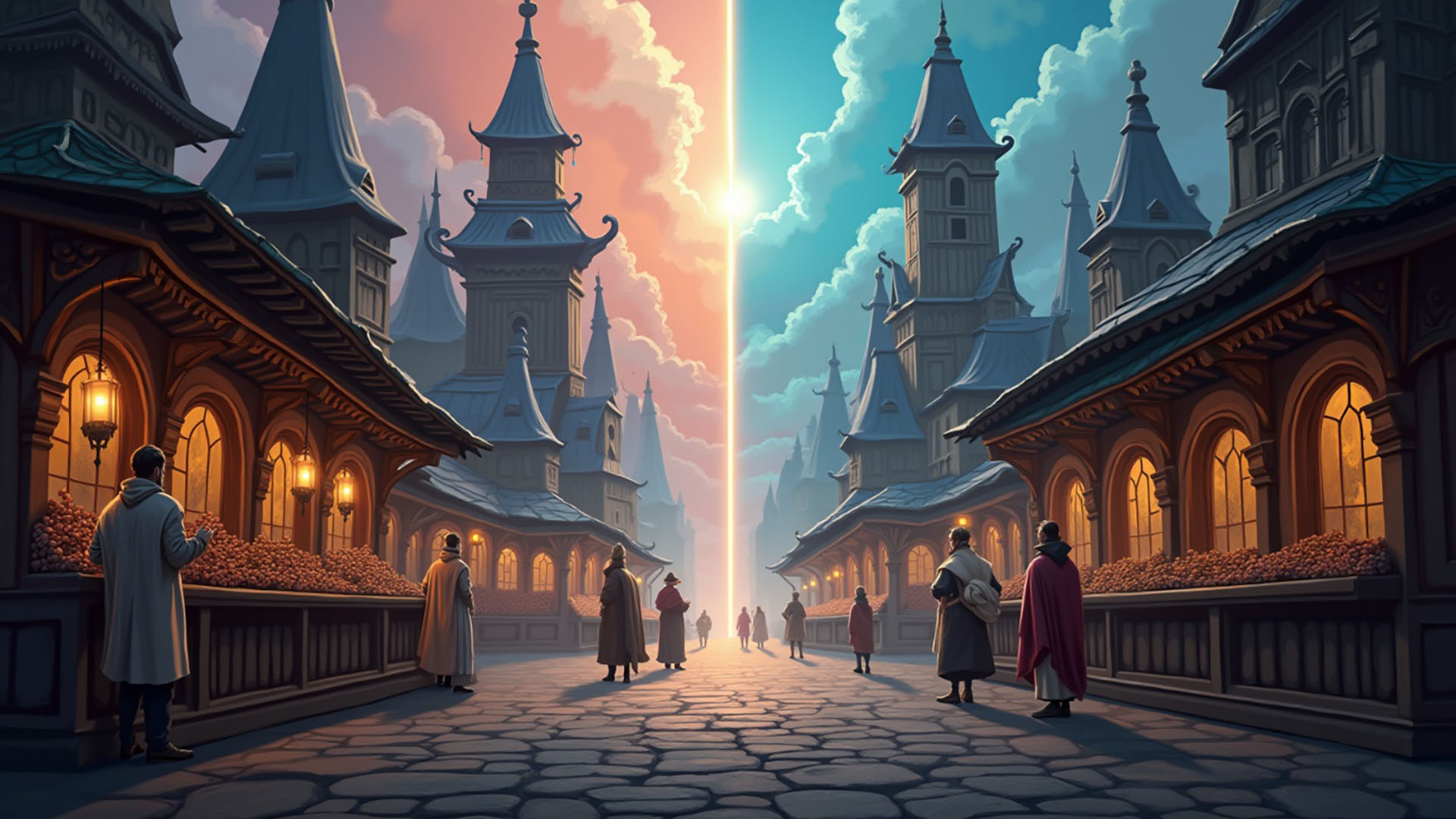
World of Warcraft has always been a game about the dead. Graveyards where you respawn, ghouls in the Plaguelands, an entire expansion devoted to the afterlife. But the real haunting is happening in the markets. The game currently runs two live economies that share a name and almost nothing else: Retail, in the Midnight expansion, and the Anniversary realms running Burning Crusade content. They operate on opposite principles, and players who wander between them routinely misjudge both.
This is a guide to how gold behaves in each, why the two feel so different, and what to expect in September 2026, just as the nights get long. The short version: someone asking how to buy wow gold retail is solving a completely different problem from someone asking the same thing about an Anniversary realm.
A Tale of Two Crypts
Retail has spent two decades adding gold sinks and gold faucets in roughly equal measure. Think of it as a sprawling gothic mansion: every room has a purpose, there are passages everywhere, and something is always moving in the walls. Classic-style realms are the opposite, a lonely cabin in the woods. Very few rooms, very few doors, and every one of them matters, because the original game was never designed around a mature economy at all.
The result is that gold in Retail is abundant and has many uses, while gold on Anniversary realms is scarce and has few but critical ones. The wording of the question is nearly identical. The horror is not.
Retail: The Mansion That Keeps Growing
Midnight introduced player housing, and housing changed the Retail economy more than any single system in years. It is a sink that never resets when a season ends, much like a haunted house that keeps demanding new furnishings. Decor is tradeable, professions (Inscription and Alchemy especially) supply a large part of it, and prices run from a few hundred gold for common crafted items to several hundred thousand for rare drops. Imagine a candlelit parlor, a cursed mirror above the mantel, and a very long shopping list.
Beyond housing, Retail gold goes toward:
- Consumables for raiding, which spike at the start of each season like a swarm at dusk
- Enchants and gems, replaced constantly during a new tier
- Auction House gear to patch weak slots early
- Mounts, pets, transmog and other collection items, the trophies on the wall
The WoW Token gives the whole thing a floating public price, a kind of séance for the market’s mood. Through late August 2026, the US gold price sat around 257,000 to 273,000 gold. That is a high band, driven by Season 2 consumable demand from 18 August and the return of a mount bundle to the shop.
Anniversary Realms: A Ghost of 2007
The Anniversary realms are on Phase 3 as of September 2026: Black Temple and Mount Hyjal, the Tier 6 content. Phase 4, Fury of the Sunwell, sits on the roadmap for autumn 2026 without a confirmed date, a looming shadow on the calendar.
Gold there behaves the way it did in 2007. There is no meaningful crafting economy at the scale Retail has, income is capped by quest and drop rates rather than by player effort, and the sinks are few but unavoidable. Like any good haunting, they keep coming back:
| Sink | Why It Matters |
|---|---|
| Epic flying | A large, fixed cost that gates open-world efficiency |
| Raid consumables | Required per attempt, not per week |
| Enchants and gems | Expensive relative to income |
| Respec costs | Recurring for anyone playing more than one role |
The WoW Token has been datamined in Classic builds and persists in the live client, but it has not been activated on Anniversary realms, and Blizzard has not confirmed any plan to do so. That absence matters. It means there is no official gold faucet at all on those realms. Nobody is coming to rescue you.
The Two Economies Side by Side
| Category | Retail (Midnight) | Anniversary (TBC) |
|---|---|---|
| Income ceiling | Effectively uncapped via professions and AH | Capped by drop and quest rates |
| Main sink | Player housing, permanent | Epic flying, consumables |
| Seasonal reset | Yes, gear resets each season | No, phase progression only |
| Official Token | Active, floating price | Not activated |
| Crafting economy | Deep, housing-driven | Narrow, raid-consumable driven |
| Typical player concern | Funding a project | Affording to raid at all |
Why the Same Word Means Different Things
On Retail, a player short of gold is usually short of a want: a housing piece, a collection item, a mount. Raiding itself is affordable for anyone doing the weekly content.
On Anniversary realms, a player short of gold is often short of a requirement. Consumables for a Tier 6 raid night are a genuine recurring cost, and falling behind on them affects raid performance directly. The social pressure is different because the consequence is different. Nobody wants to be the one who runs out of potions while the Black Temple lights go out.
What This Means for Your Time
The two economies also value time differently. Retail rewards market knowledge: knowing which housing decor is in demand, when consumable prices spike, which professions have margin. An hour spent well on the Auction House can outperform many hours of gathering.
Classic-style realms reward raw hours far more directly. There is less arbitrage available, so income tracks time spent. That is part of the appeal for some players, and part of the grind for others. Call it the graveyard shift.
What is Lurking Ahead
Retail’s next step is patch 12.1.5, The Promise of Tomorrow, revealed on 3 September and currently on the public test realm. It adds a story campaign, a one-boss raid called The Unbinding of Kith’ix, an Aqir Invasion outdoor event, a solo-friendly content type called Labyrinths, and a new upgrade currency, Ascendant Venomstones. No live date has been announced.
The Anniversary realms are waiting on Phase 4 and the Sunwell. Historically, a new phase on a Classic-style realm produces a sharp demand spike for consumables and pre-raid gear in the weeks before launch, followed by a slow decline. Players who prepare early benefit considerably more than their Retail counterparts, because the supply side cannot respond as quickly. The smart ones stock the cellar before the storm.
The Practical Takeaway
If you play both, treat them as separate games economically. Retail gold is a project budget: plan it around housing and collections, and watch the Token price as a demand gauge. Anniversary gold is an operating cost: keep a working buffer for consumables and flying, because running dry there limits what you can participate in rather than what you can decorate.
Neither approach transfers. The most common mistake players make is bringing Retail habits (holding gold, waiting for a sale, relying on the Auction House) to a realm where none of those instincts apply. It is the classic horror movie error: splitting up and assuming the rules still hold.
A Third Economy Rises Near Halloween
The Retail-versus-Classic comparison is about to get more complicated. At BlizzCon 2026, held in September, Blizzard announced World of Warcraft: Forever, a Classic+ branch built on expanded vanilla content, launching 4 November 2026 with beta access from 17 September. It is included in the existing subscription and positioned as a third permanent version alongside Retail and Classic. It arrives just days after Halloween, as if something had been waiting for the candles to burn down.
The detail that matters economically is that Forever will be realmless. Players choose a ruleset rather than a server and stay within it. Every previous Classic-flavored release has been built on realms, and the realm boundary is what produced the characteristic thin, volatile Classic market. In horror terms, the walls between the isolated villages are coming down.
| Category | Retail | Anniversary | Forever |
|---|---|---|---|
| Market structure | Region-wide | Per realm | Realmless, details unannounced |
| Official Token | Active | Not activated | Not announced |
| Main sink | Housing | Epic flying, consumables | Vanilla costs presumed |
| Raid schedule | Seasonal | Phase-based | Raids reported 9 December |
Blizzard has not explained how trade or the Auction House will work without realms, so anything beyond that table is inference. What can be said is that a larger shared pool usually produces deeper, less volatile markets, which would make Forever’s economy less like Classic’s than its content suggests.
For players who move between versions, the advice does not change. Treat each economy on its own terms, and do not assume the habits that work in one will survive in another. Azeroth has more than one kind of haunting, and each has its own rules.
Support Halloween Love
If an item was discussed in this article that you intend on buying or renting, you can help support Halloween Love and its writers by purchasing through our links:
