
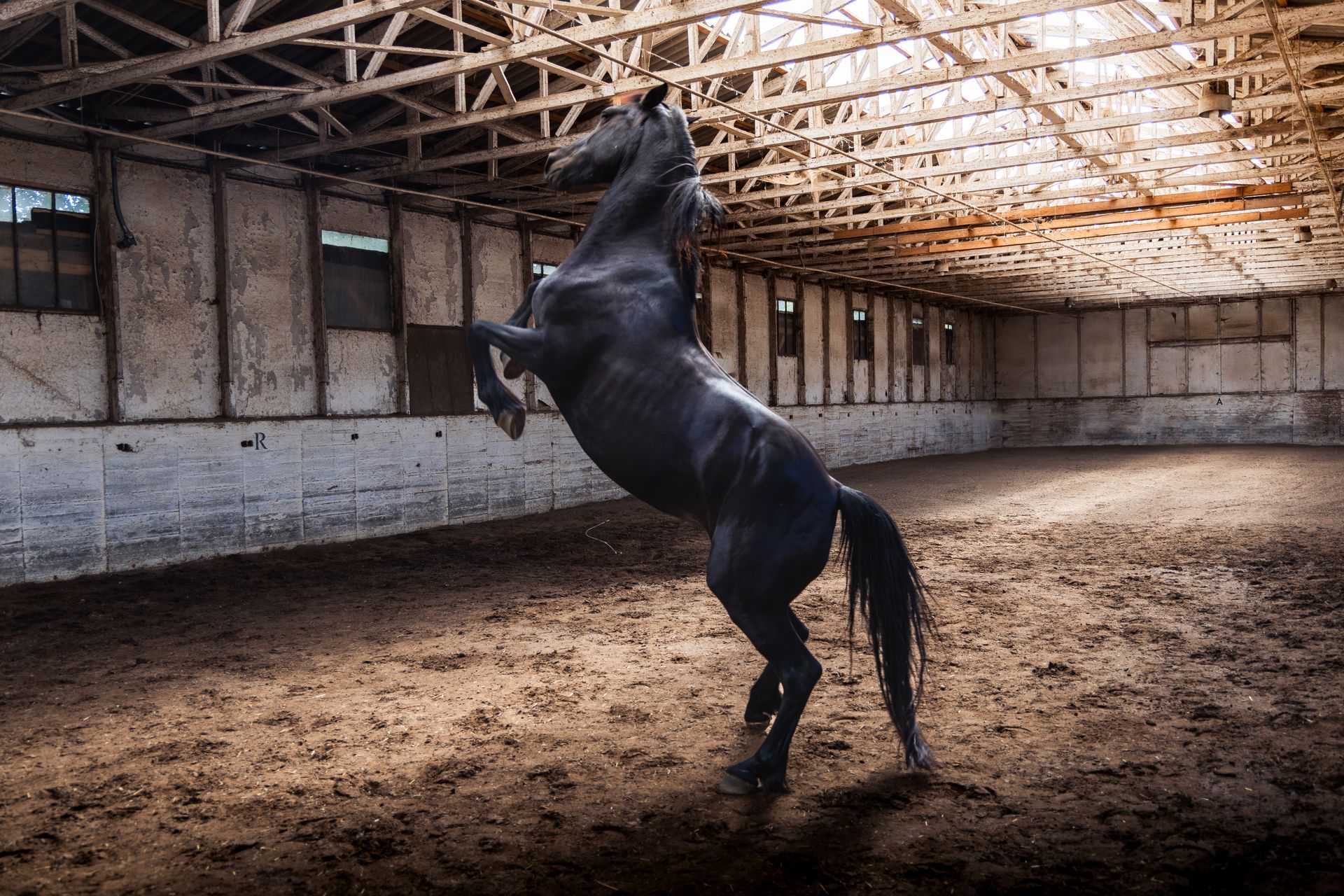
What’s the first thing that comes to mind when we talk about scary stories? Probably ghosts, right? Well, did you know that there are even scarier and spine-chilling stories around horses?
Yeah, horses. Horses are unique animals. They are cute and lovely when looking at them in a picture, but when you stand next to a 1,000-pound horse, your heart starts racing even though the horse looks like it’s not even noticing you.
So, horses are both spooky and lovely at the same time. It all comes down to the atmosphere, the story, and the overall vibe. On top of that, horses carry deep symbolism. They are often connected to mythology and folklore; throughout history, they’ve been given different meanings, which led to the birth of the spooky side.
The Headless Horseman Became America’s Great Ghost Rider
If you’re into supernatural things, you are probably already familiar with Washington Irving’s Headless Horseman story. This is one of the most popular examples of showing horses as creatures of the underworld and definitely one of the spookier stories.
Irving published The Legend of Sleepy Hollow in 1820, setting the story in New York’s Hudson Valley. Schoolmaster Ichabod Crane hears local tales about the ghost of a Hessian soldier (supposedly decapitated during the American Revolution). According to the legend, the soldier rides through the countryside at night searching for his missing head.
Yes, rides on a scary horse that looks nothing like the Thoroughbreds in this year’s Breeders’ Cup Classic. Okay, it might look similar to Knightsbridge, which is considered one of the favorites at the Breeders’ Cup, especially after the dominant win in the Pacific Classic at Del Mar. But if you are trying to bet on the Breeders’ Cup at TwinSpires.com, comparing the horses to scary stories isn’t going to help. You should probably do your own research because horse racing is a sport where appearance doesn’t matter that much. It is all about speed.
Anyway, what makes Irving’s story clever is that he never completely confirms the supernatural explanation. Ichabod disappears after the encounter, while a shattered pumpkin is found nearby.
So, you’ll be left wondering whether the legendary Horseman actually appeared or whether Ichabod was so frightened out of town by a weird joke.
Ireland Had Headless Riders of Its Own
America was hardly alone in imagining headless people with excellent horsemanship.
Irish folklore developed traditions surrounding the Dullahan, a supernatural headless figure often depicted riding a black horse while carrying its own head. Nineteenth-century collector Thomas Crofton Croker included Dullahan stories in the 1828 volume of Fairy Legends and Traditions of the South of Ireland.
Later versions turned the figure into an especially grim omen of death. A rider travelling quickly along an isolated road is already dramatic enough. Giving him his head under one arm does not improve matters.
It is tempting to say the Dullahan directly inspired Irving’s Sleepy Hollow Horseman, but the history is not that simple. Headless riders occur across several European traditions, and Irving’s story appeared eight years before Croker’s published Dullahan collection. Oral stories obviously existed before they were printed, but there is no solid evidence establishing a direct Dullahan-to-Ichabod pipeline.
The Irish Death Coach Somehow Makes Things Worse
Ireland also produced the Cóiste Bodhar, usually translated as the silent or deaf coach.
Records in Ireland’s National Folklore Collection preserve local accounts of mysterious coaches heard travelling through the countryside at night. One County Clare tradition described a four-wheeled coach pulled by four headless horses and driven by a headless man, with its appearance followed by a death in the neighborhood. Other accounts describe rattling chains, wheels, and an unseen coach passing isolated roads after midnight.
This is an impressive escalation.
One headless rider was apparently insufficient.
The Cóiste Bodhar belongs to a wider family of European death-coach traditions in which a supernatural carriage announces or accompanies approaching death. The horror comes partly from the sound. People hear wheels, chains, and hooves before seeing anything, or sometimes without seeing anything at all.
The Wild Hunt Turned the Entire Sky Into a Haunted Road
Then there is the Wild Hunt, one of Europe’s greatest supernatural riding traditions.
The basic image is unforgettable: a furious nocturnal procession of spectral hunters, riders, animals, or dead souls tearing across the sky or countryside.
But there is an important historical complication. The Wild Hunt was never one perfectly consistent ancient story spread unchanged across Europe. Historian Ronald Hutton notes that the term became an umbrella for different traditions of supernatural nighttime processions after Jacob Grimm brought them together during the nineteenth century. Different regions gave the procession different leaders, including figures associated with Odin, legendary kings, spirits, and other supernatural hunters.
That actually makes the legend more interesting.
Scotland’s Kelpie Looked Like the Horse You Should Never Ride
Not every frightening supernatural horse needed a rider.
Scottish folklore gave us the kelpie, a water spirit often appearing in the shape of a horse near rivers, pools, and lochs.
The creature could appear harmless enough to approach or ride. That was the problem.
According to traditions recorded by Historic Environment Scotland, anyone who climbed onto the kelpie’s back could be carried into the water and disappear. Kelpies were also said to assume human form, sometimes revealing themselves through water weeds or other signs associated with their aquatic nature.
There are many more examples where horses have passed into the supernatural world, and everything is highlighted in one of the scariest legends you’ll ever hear. Of course, horses had a deep relationship with humans that stretches back thousands of years, so it is not surprising that they’ve also entered the world of spooky stories. After all, you cannot stop human imagination, right?
Support Halloween Love
If an item was discussed in this article that you intend on buying or renting, you can help support Halloween Love and its writers by purchasing through our links:
