
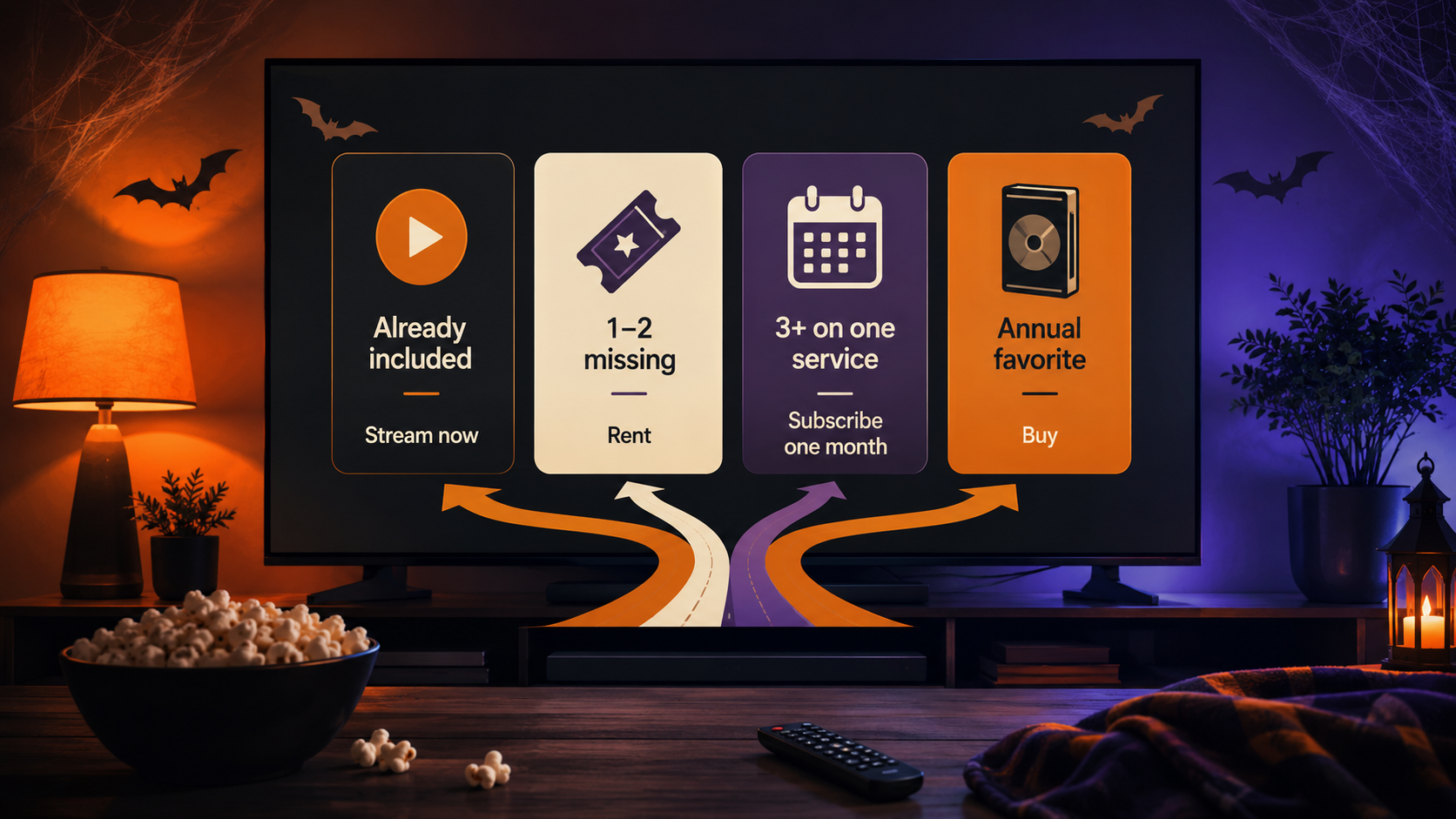
The movie list is ready: a handful of films, one long October night, and enough snacks for a double feature that somehow became a triple feature. Then the plan starts collecting charges. Three titles are included with services you already have, two require another subscription, and the last costs extra everywhere. The cheapest route depends on how many films share one service, what is already active, and whether a favorite will return next Halloween.
That situation is familiar to committed movie fans. Deloitte’s 2026 Digital Media Trends research found that US households with paid video subscriptions have four services on average. Before adding another plan, list every film and mark its current status in your country: included, ad-supported, rentable, purchasable, or unavailable. The decision begins with the gaps. If films are only one part of the evening, keep any other paid entertainment visible in the total while calculating its cost separately.
Price the Whole Halloween Night
A movie marathon may be the center of the evening without being its only paid entertainment. Games and other activities can enter the plan after the lineup is settled. Put those extras on the same planning sheet, while keeping their pricing separate from movie access.
One example of that broader entertainment mix appears on Lucky Rebel, whose catalog includes Halloween-themed titles, many of which are ideal for a quick round between films, or even for firing up during a slow scene. There’s something rather thrilling about matching the game to the film; pick a zombie-themed title if you’re watching something with the undead, or go for ghosts or vampires or terrifying monsters if they feel more in theme.
That mix matters because a Halloween night may include both watching and playing; it’s nice to have options with different pacing and interaction levels available. However, the costs are not interchangeable, and games should be viewed as separate items if they are genuinely part of the evening.
Once you’ve separated them out, you can compare movie-access costs and assess what your overall budget looks like. Did you know that a lot of subscription services have risen significantly in the last few years? That makes costing them carefully more important. Add every new movie-access charge, count how many chosen films each option unlocks, and calculate the cost per film. Keeping other activities separate prevents a misleading comparison.
Run the Six-Film Test
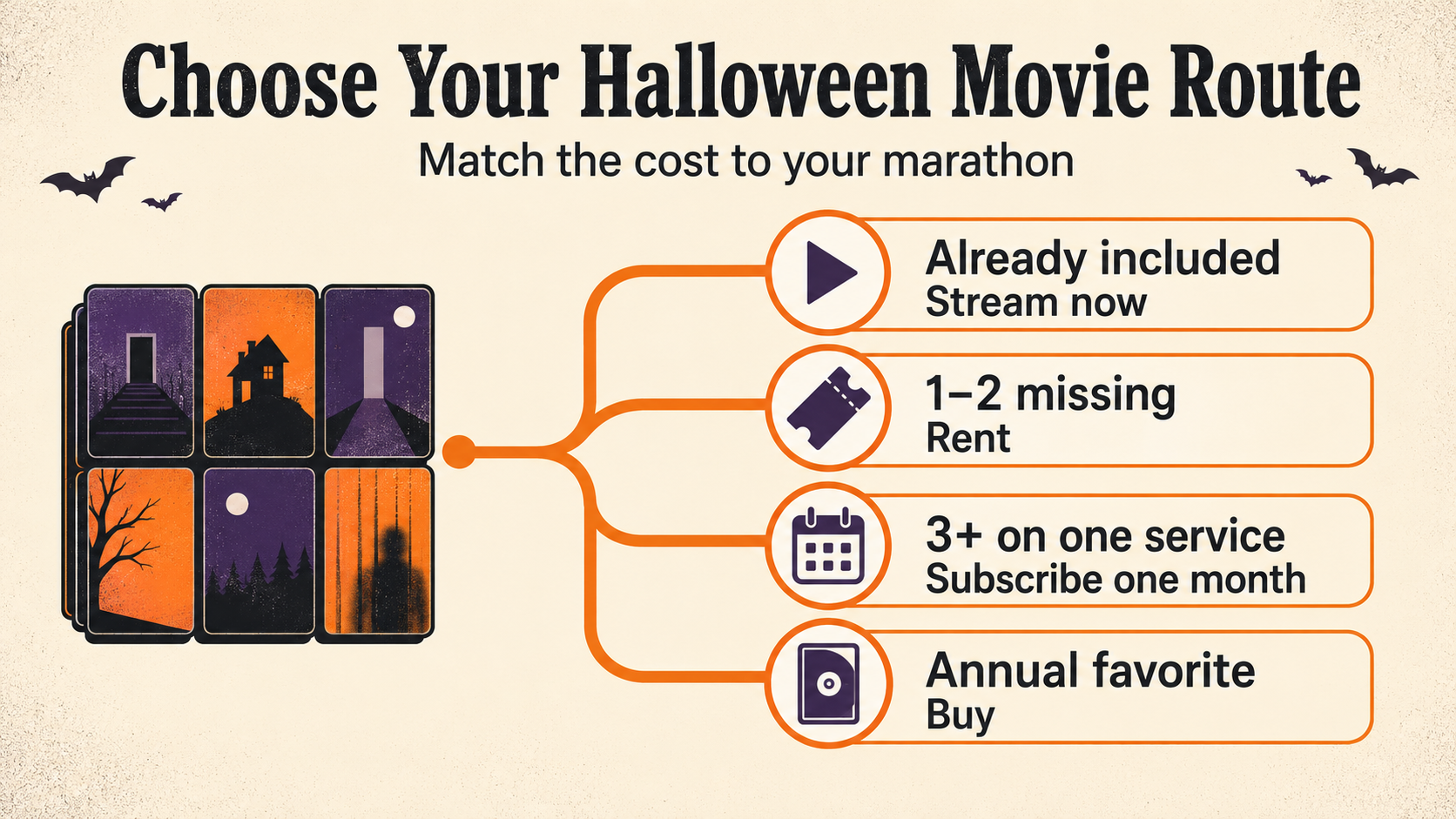
Use a hypothetical list, so changing catalogs and temporary offers do not distort the rule. Suppose 3 movies are included with an active service, 2 sit on the same inactive service, and 1 annual favorite can be rented for $4 or purchased for $20.
| Access Route | Added Cost | Best Use |
|---|---|---|
| Existing subscription | $0 | Watch titles already included |
| 1-month activation | $10 | Use when cheaper than separate rentals |
| Individual rental | $4 per film | Fill 1 or 2 isolated gaps |
| Purchase | $20 | Consider for a repeat favorite |
Renting two films for $8 beats a $10 activation fee. Renting the final favorite brings the night’s added cost to $12. Buying it raises the total to $28, so the extra $16 gains value only if you will watch it multiple times in the future. At these example prices, 5 rentals equal one $20 purchase. That is the break-even point, not proof that buying is automatically better.
Build the lineup before checking prices. A themed selection begins with mood and pacing rather than whichever service happens to be open. Once the choices are fixed, verify every title in the same country and distinguish subscription inclusion from rental or purchase availability.
Compare the Charge You Will Actually Pay
Monthly equivalents compare rates, but they do not necessarily show the amount leaving your account today. If an annual plan would be purchased solely because of this marathon, the full payment is the immediate outlay. Dividing it by 12 can help with long-term budgeting, but only realistic future viewing should reduce its cost per use.
Temporary discounts and trials need a similar check. Confirm the checkout price, when normal billing begins, and whether the selected films are included rather than offered as additional rentals. A low subscription price does not help when the 2 missing movies still cost extra.
Buy When Repeat Value Is Real
A physical copy and a digital purchase are different forms of access. A disc gives you possession of that edition, while a digital purchase generally depends on a retailer’s account and terms. Disc buyers may value packaging, bonus material, picture quality, or dependable access when catalogs change. Digital purchases favor immediate viewing and require no shelf space. Neither automatically wins on price.
Physical media still has a concentrated audience. What Hi-Fi? reported that US 4K Blu-ray sales rose 12% in 2025 compared with 2024, even as the broader physical-media market declined. Horror fits that split well: streaming supports discovery, rentals cover isolated gaps, and purchases preserve movies that repeatedly earn a place in the lineup.
Settle the marathon first, then price the routes. Count new charges, compare billing periods, and calculate repeat watches separately. One Halloween night may use a subscription for 3 films, rentals for 2, and a disc for the favorite.
Support Halloween Love
If an item was discussed in this article that you intend on buying or renting, you can help support Halloween Love and its writers by purchasing through our links:
